



Introduction
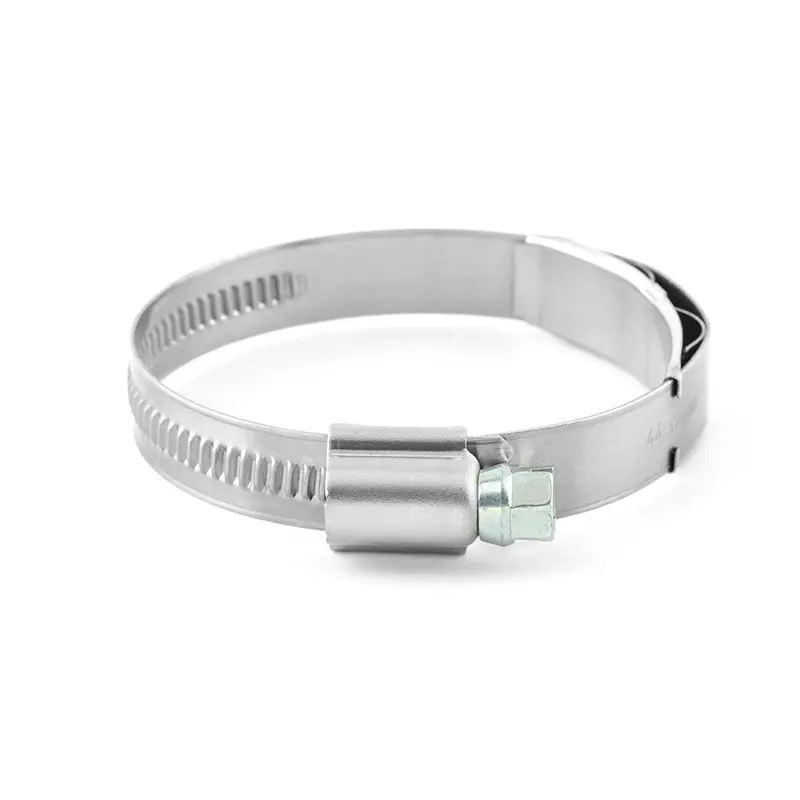
If you have ever watched a coolant hose slip off a hot engine block or a fuel line weep under pressure, you already know that the humble hose clip is not a commodity—it is a critical sealing component. Among the many varieties available, stainless steel hose clips built to the DIN3017 standard with a riveted construction and an integrated compensator represent a distinct step up in reliability.
What Makes DIN3017 Clamps Different from Generic Worm Gear Clips
Most people picture a worm gear clamp when they hear "hose clip." That design uses a threaded band and a captive screw. It works, but it has a well-known weakness: the band can distort under torque, and the screw housing creates a localized pressure point that may cut into soft hoses.
DIN3017 is a German standard that tightens the tolerances. A DIN3017 clamp still uses a worm gear mechanism, but the band, housing, and screw are manufactured to stricter dimensional and material specifications. The result is more uniform clamping force around the circumference and less risk of band deformation. When you add riveting instead of spot welding at the housing, you eliminate a common failure point where welds can crack under vibration.

The Role of the Compensator
The term "compensator" in a hose clamp context refers to a design feature that absorbs dimensional changes. Hoses expand when hot and contract when cold. A rigid clamp that cannot flex with the hose may lose tension over thermal cycles, leading to leaks.
A compensator—sometimes called a spring compensator or elastic element—keeps the clamping force relatively constant across a range of temperatures and hose diameters. In practice, this means the clamp maintains a reliable seal even when the hose wall compresses over time or the system sees repeated heat cycling. For applications like charge air coolers, heater circuits, and hydraulic return lines, that consistency is the difference between a dry engine bay and a recurring drip.
12mm Band Width: Why It Matters
Band width is not just a number. A 12mm band spreads the clamping load over a wider strip of hose than a narrower 9mm band. This reduces the risk of cutting or pinching the hose cover, especially on silicone or EPDM hoses with softer outer layers. At the same time, 12mm is still narrow enough to fit in tight spaces where a wider 14mm or 16mm band would interfere with nearby components.
For the 12mm riveting DIN3017 Germany type hose clamp with compensator, the band width is matched to the riveted housing geometry. That means the housing does not protrude excessively, and the screw remains accessible with a standard nut driver or flat-head screwdriver.

Material Selection: Stainless Steel Grades
The phrase stainless steel hose clips covers a range of alloys. The most common are AISI 304 (often marked W1 or W2) and AISI 316 (W3 or W4). For the clamp discussed here, the band and housing are typically formed from 304 stainless steel, with the screw in either 304 or a hardened grade.
304 stainless offers good corrosion resistance for most automotive and industrial environments. If the clamp will be exposed to road salt, marine atmospheres, or chemical washdown, 316 stainless is the better choice. 316 contains molybdenum, which improves resistance to chlorides and pitting. Always confirm the grade with your supplier, because "stainless" alone is not a specification.
Riveting vs. Welding: A Durability Comparison
Spot-welded hose clamps are everywhere. They are fast to produce and inexpensive. But the weld nugget creates a heat-affected zone that can be brittle. Under vibration—common in engine compartments, off-road equipment, and marine engines—a welded housing may develop micro-cracks and eventually fail.
Riveting avoids that heat-affected zone. The rivet mechanically joins the housing to the band, and a properly set rivet can withstand significant shear and vibration. In the 12mm DIN3017 clamp, the riveting process is controlled to ensure the housing stays aligned with the band and the screw threads remain clean. This is not a cosmetic difference; it is a functional one that affects long-term sealing.

Where This Clamp Performs Best
The combination of DIN3017 tolerances, 12mm band width, riveted housing, and compensator makes this clamp suitable for:
Automotive cooling systems: Radiator hoses, heater hoses, and thermostat housings where thermal cycling is constant.
Charge air and intercooler piping: Silicone boots and aluminum pipes that need a firm but non-damaging clamp.
Marine engines: Raw water and coolant lines where corrosion resistance is non-negotiable.
Industrial machinery: Pneumatic and hydraulic lines that see vibration and pressure pulses.
Agricultural equipment: Dust, vibration, and temperature swings demand a clamp that stays put.
In each case, the compensator helps maintain tension, while the riveted DIN3017 body resists the mechanical stresses that cause lesser clamps to loosen.
Installation Notes for Best Results
Even the best clamp can underperform if installed poorly. A few practical points:
Check hose condition. Replace any hose that shows cracking, swelling, or hardening. A clamp cannot compensate for a failing hose.
Position the clamp correctly. Place it behind the bead or barb, not on it. The clamp should sit on the straight section of the fitting.
Tighten to specification. Over-tightening can cut the hose or strip the screw. For most 12mm DIN3017 clamps, a torque around 3–5 Nm is typical, but always follow the hose or equipment manufacturer's recommendation.
Re-check after heat cycles. Thermal expansion can slightly loosen the clamp. A quick re-torque after the first few operating cycles is good practice.
Use the right tool. A nut driver or a screwdriver that fits the slot properly avoids damaging the screw head.


About Us
We manufacture and supply stainless steel hose clips engineered to DIN, ASFA, and other international standards. Our product range includes worm gear clamps, T-bolt clamps, spring clamps, and specialty clamps with compensators. Every batch is checked for band width, material grade, torque performance, and rivet integrity. We work with distributors, OEMs, and maintenance teams who need consistent quality rather than occasional good samples. If you need a clamp that holds under real-world conditions, our team can help you specify the right configuration.
FAQ
Q: What does "DIN3017" mean on a hose clamp?
A: DIN3017 is a German standard that specifies dimensions, materials, and performance requirements for worm gear hose clamps. A DIN3017 clamp meets tighter tolerances than a generic clamp, which leads to more consistent clamping force.
Q: Why does this clamp have a compensator?
A: The compensator absorbs changes in hose diameter caused by temperature swings and aging. It helps maintain steady clamping force, reducing the chance of leaks over time.
Q: Is 304 stainless steel good enough for marine use?
A: For freshwater and occasional salt spray, 304 is often acceptable. For constant saltwater exposure or chlorinated environments, 316 stainless is the better choice because it resists pitting and crevice corrosion more effectively.
Q: Can I reuse a riveted DIN3017 clamp?
A: In many cases, yes, if the screw threads and band are undamaged. However, for critical applications, replacing the clamp is cheap insurance. Never reuse a clamp that shows deformation, cracked housing, or stripped threads.
Q: What is the difference between a 9mm and 12mm band width?
A: A 12mm band spreads the load over a wider area, which reduces the risk of cutting into soft hoses. It also provides more contact surface for a secure seal. A 9mm band is lighter and fits tighter spaces, but it concentrates force on a narrower strip.
Q: How do I know if my clamp is too tight?
A: If the hose bulges excessively around the clamp, or if the hose cover is cut or indented, it is too tight. Use a torque wrench where possible and follow the hose manufacturer's specification.
Q: Do you offer custom sizes or materials?
A: Yes. We can produce clamps in different band widths, diameters, and stainless steel grades. Contact us with your specification, and we will confirm feasibility and lead time.
Certificate


FAQ
Q: What's the difference between 304 stainless and galvanized steel?
A: 304 stainless offers superior corrosion resistance, making it ideal for marine, chemical, or outdoor use. Galvanized steel is more affordable and still provides good rust protection for indoor or light-duty applications.
Q: How do I choose the right size clamp?
A: Measure the outer diameter of your hose (or pipe) when it's installed. Then pick a clamp whose range covers that measurement. For example, a 20mm hose would use the 20–32mm clamp.
Q: Are these clamps reusable?
A: Yes, they are reusable. However, inspect the band and threads for wear before reinstallation, especially if they've been under high torque.
Q: Can I use these clamps on soft hoses?
A: Yes, but we recommend using the 12mm bandwidth for softer materials, as it distributes pressure more evenly and reduces the risk of cutting or pinching.
Q: Do you offer custom packaging or branding?
A: Yes. We provide various packaging options (poly bags, boxes, blister packs) and can apply stencil or laser marking upon request.
Hot Selling Products


Post time: Sep-30-2026


