



Why Most Hose Clamps Fail—and How the British Type Solves It
A hose clamp is a simple device. Yet in real-world installations—pumps that vibrate, engines that heat-cycle, irrigation lines that bake in the sun—simple devices fail in predictable ways. The band teeth wear down. The housing flexes. The screw backs off. Six months later, a drip appears where a seal used to be.
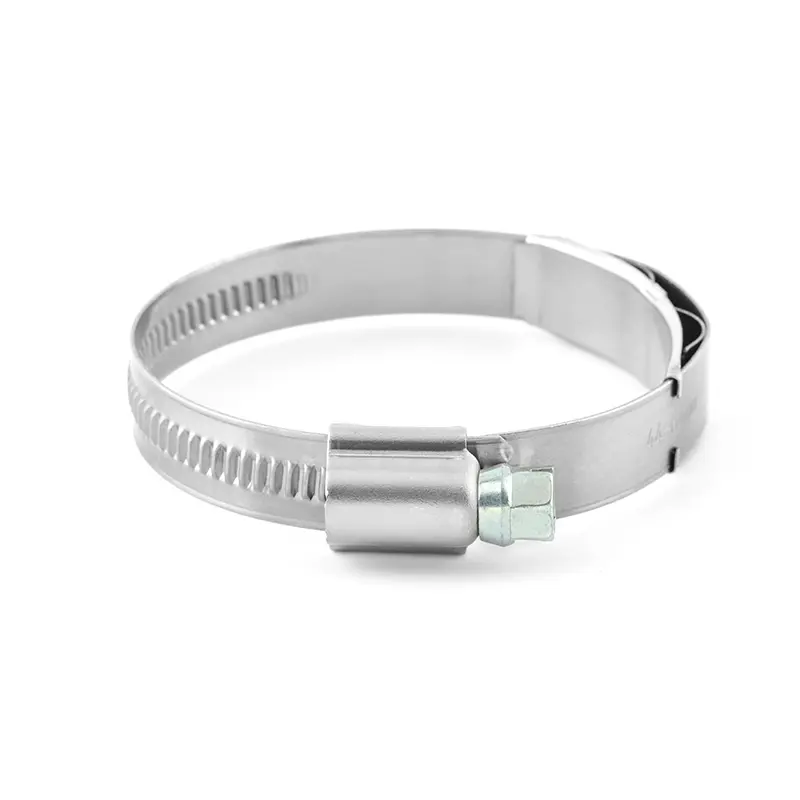
The British type hose clamp approaches this problem differently. Instead of relying solely on tooth engagement between the band and the screw, it uses a riveted shell structure that mechanically locks the band to the housing. This is not a cosmetic detail—it changes how the clamp behaves under vibration and thermal expansion.
Glorex manufactures this clamp in full 304 stainless steel (band, tongue plate, housing, and screw), covering band widths of 9.7mm and 12mm with adjustment ranges from 8mm to 230mm. The design philosophy is straightforward: maintain radial clamping force without deforming the hose, and do it for years, not months.
The Riveted Shell: What It Actually Does
Look at a conventional worm-gear clamp after a few hundred hours of service. The band has shifted slightly relative to the housing. The teeth show wear marks. The clamping force—measured in Newtons—has dropped measurably. This is the mechanism behind most "mystery leaks" in cooling systems and industrial piping.
The riveted design on the British type hose clamp addresses this at the connection point. The band and housing are joined by a rivet that prevents relative movement. When the screw tightens, the force path is direct and stable. Even under continuous vibration or pressure surges, the anti-loosening riveted shell keeps the drive mechanism and band tightly coupled. The result is a clamp that holds its initial torque rather than gradually releasing it.
For maintenance engineers, this translates to fewer re-torque procedures and fewer callbacks. For OEM assembly lines, it means consistent joint integrity without secondary locking steps.

Hose Protection: The Detail That Extends Service Life
Clamping force is only half the equation. The other half is what happens to the hose surface under that force.
Stamped clamps often carry burrs or sharp edges from the manufacturing process. When tightened, these edges bite into the hose wall—especially soft silicone or EPDM compounds. The damage is not always visible immediately, but it creates a stress concentration that can lead to weepage or sudden rupture.
Glorex finishes the inner band surface smooth and burr-free. The contact patch between clamp and hose is uniform, spreading radial force across the full band width rather than concentrating it at irregular points. For applications involving silicone hoses in food-grade or pharmaceutical settings, or rubber coolant lines in agricultural machinery, this smooth inner surface preserves hose integrity instead of compromising it.
Size Coverage and Material Grade
The clamp is available in two band widths:
| Bandwidth | Adjustment Range |
|---|---|
| 9.7mm | 8–12mm, 13–20mm |
| 12mm | 18–22mm through 190–230mm (21 sizes) |
All components—band, tongue plate, housing, and screw—are 304 stainless steel (W4 grade). This matters in wet, outdoor, or chemically exposed environments. The full 304 construction resists oxidation and chloride attack better than mixed-material clamps with zinc-plated screws or mild steel housings.
For custom band widths or non-standard ranges, Glorex accepts OEM requests. The British type hose clamp product page lists standard specifications, and the engineering team can quote modified dimensions based on application requirements.

Where This Clamp Belongs
The combination of vibration resistance and hose protection makes the British type clamp suitable for:
Residential and commercial plumbing: washing machine inlet lines, dishwasher discharge hoses, garden irrigation fittings.
Industrial equipment: cooling circuits, chemical transfer lines, food-processing conveyors (stainless version).
Transportation and heavy machinery: marine piping, railway HVAC lines, hydraulic return hoses on tractors and excavators.
In each case, the common thread is a connection that cannot be allowed to leak—and a maintenance schedule that does not include frequent clamp replacement.


About Glorex
Glorex engineers and manufactures high-performance pipe clamps for sealing-critical applications. The product range serves automotive assemblies, military equipment, air intake and exhaust systems, heating and cooling circuits, agricultural irrigation, and industrial drainage networks.
The company operates with a team of nearly 100 professionals across sales, design, manufacturing, and after-sales support. Fifteen specialists handle pre-sales and post-sales service, while eight technical staff—five with senior engineering titles—manage product development and quality control. The workplace culture is open, results-driven, and oriented toward continuous improvement.
Certificate


FAQ
Q: How is the British type clamp different from a standard worm-gear clamp?
A: The British type uses a riveted connection between the band and housing. This prevents the band from shifting under vibration, which is the primary cause of clamping force loss in conventional worm-gear clamps. The inner band is also finished smooth to protect soft hoses.
Q: Is the entire clamp 304 stainless steel, or just the band?
A: All four components—steel belt, tongue plate, housing, and screw—are 304 stainless steel. This is the W4 grade, suitable for wet and outdoor environments.
Q: Can I order a custom size not listed in the table?
A: Yes. Glorex accepts custom band widths and adjustment ranges. Contact the sales team with your specification, and the engineering department will confirm feasibility and lead time.
Q: What is the minimum order quantity?
A: Standard MOQ is 500–1000 pieces per size. Trial orders are welcome for first-time buyers.
Q: Can the clamp be branded with our company logo?
A: OEM projects are available with appropriate authorization. Logo printing and custom packaging (white, black, or full-color cartons) can be arranged.
Hot Selling Products


Post time: Nov-19-2026


