



Why Small Hose Clamps Deserve More Attention Than They Get
A clamp that costs less than a cup of coffee can shut down an engine bay, a cooling loop, or an irrigation line if it fails. That is the strange economics of small hose clamps: tiny component, outsized consequence.
Most buyers focus on the hose. The clamp is an afterthought — until a drip appears under a dashboard, or a military air-intake line loses pressure at the wrong moment. In practice, the clamp is the part that decides whether a seal holds for ten years or ten weeks.
What Counts as a "Small" Hose Clamp?
There is no universal cutoff, but in the trade, small hose clamps generally refer to clamps with a clamping range starting below 20 mm and often as low as 8–10 mm. These are the clamps used on fuel lines, vacuum hoses, PCV systems, small coolant bypass lines, and compact pneumatic tubing.
Mini hose clamps — sometimes called micro or compact clamps — push the range even lower, down to 6 mm or so. Their small band width and low profile matter in crowded engine bays where a standard worm-gear clamp simply will not fit without chafing a neighboring component.
The key point: small does not mean low-spec. A 10 mm clamp on a fuel return line faces the same chemical exposure, vibration, and thermal cycling as a 60 mm clamp on a radiator hose.

The Three Decisions That Determine Seal Quality
1. Band and Housing Material
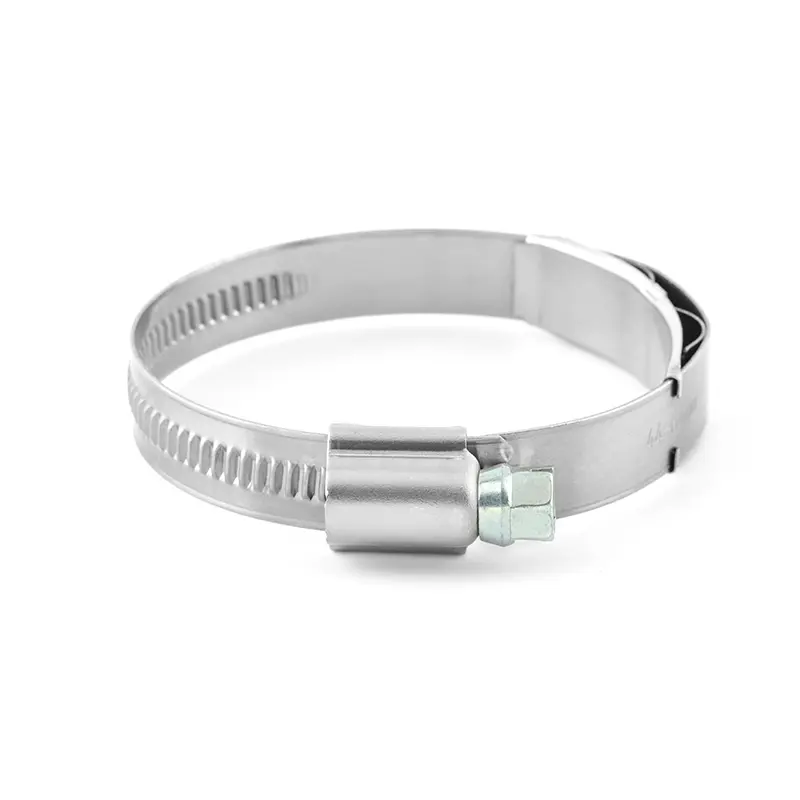
For stainless steel hose clamps, stainless steel is the default for good reason. Grade 304 handles general automotive and industrial use. Grade 316 is the choice for salt exposure, marine environments, and certain chemical lines. Zinc-plated steel is cheaper but has a shorter service life in humid or washdown conditions.
One detail worth checking: whether the screw and band are the same grade. Mixed materials can accelerate galvanic corrosion at the housing.
2. Clamping Range vs. Hose OD
A clamp rated 8–12 mm should be used on a hose with an outside diameter near the middle of that range — not at the extreme. Running a clamp at its maximum opening reduces the reserve tightening travel and can distort the band. Running it at the minimum can crush thin-walled tubing.
Measure the hose OD with the fitting inserted, not the bare hose. The fitting adds 1–3 mm depending on wall thickness.
3. Tightening Method
Worm-gear clamps are the workhorse: adjustable, reusable, widely understood. But for small diameters, the band width and thread pitch matter. A coarse thread on a 10 mm clamp gives less fine control than a finer pitch.
For high-vibration applications, constant-tension clamps or spring-band clamps hold torque better because they compensate for hose compression over time. The trade-off is that they are size-specific and less forgiving if the hose OD is not measured accurately.


Where Small Hose Clamps Earn Their Keep
Automotive: fuel lines, vacuum lines, PCV systems, small coolant bypass hoses, turbocharger oil feed and return lines.
Military and defense: air intake systems, compact cooling circuits, and field equipment where a leak is not an inconvenience but a failure mode.
Air intake systems: small clamps secure sensor lines and vacuum reference hoses; a loose clamp here can trigger fault codes.
Engine exhaust and cooling/heating systems: smaller clamps handle EGR lines, heater core hoses, and overflow connections.
Irrigation and industrial drainage: drip-line connections, small-diameter manifold fittings, and chemical dosing lines.
The common thread is tight space and a zero-tolerance expectation for leakage. That is why the sealing performance of a small clamp is judged less by its appearance and more by whether it still holds after a thousand thermal cycles.

A Practical Sourcing Checklist for Small Hose Clamps
Before requesting quotes, confirm these five points:
Hose OD with fitting installed — not the nominal hose size.
Band width limit — crowded assemblies may need a narrow-band mini clamp.
Material grade — 304 vs. 316 vs. plated steel, and whether screw and band match.
Tightening type — worm-gear, constant-tension, or spring-band.
Corrosion environment — road salt, washdown, marine air, or chemical splash.
Buyers who supply these details upfront tend to get accurate quotes on the first pass and fewer fitment surprises at installation.


About Us
Mika (Tianjin) Pipeline Technology Co., Ltd is based in Tianjin, one of China's four municipalities and a strategic fulcrum of the Maritime Silk Road. The city sits at the intersection of the Belt and Road, with government positioning as an international integrated transportation hub.
We provide reliable, high-quality pipe clamp products engineered for non-leakage seal performance. Application areas include automotive, military, air intake systems, engine exhaust systems, cooling and heating systems, irrigation systems, and industrial drainage systems.
Our team of nearly 100 employees includes 15 pre- and after-sales specialists and 8 technicians, among them 5 senior engineers. We maintain a sunny, pragmatic, and upward company culture — a way of working that shows up in how we handle specifications, deadlines, and after-sales follow-through.
For buyers evaluating small hose clamps, the starting point is a clear specification and an honest conversation about the operating environment. That is where a reliable seal begins.


FAQ
Q: What is the difference between a small hose clamp and a mini hose clamp?
A: The terms overlap, but "mini" usually refers to clamps with a narrower band and a lower minimum diameter — often 6–8 mm — designed for very tight spaces. "Small" is a broader category covering clamps up to roughly 20 mm.
Q: Can small hose clamps be used on fuel lines?
A: Yes, provided the band and screw material are compatible with the fuel and the environment. Stainless steel 304 or 316 is common. Avoid zinc-plated clamps on fuel systems where corrosion products could contaminate the line.
Q: How tight should a small hose clamp be?
A: Tight enough to compress the hose without cutting into it. Over-tightening distorts the band and can crush thin-wall fittings. For critical lines, use a constant-tension clamp or follow the hose manufacturer's torque guidance.
Q: Do small hose clamps work on silicone hoses?
A: They can, but silicone compresses and relaxes more than rubber. A constant-tension or spring-band clamp is often a better match because it maintains force as the hose settles.
Q: What is the typical lead time for bulk small hose clamp orders?
A: It depends on material, size, and whether the clamp is a standard or custom item. A supplier with in-house design and production — like Mika Pipeline in Tianjin — can usually confirm scheduling quickly once specifications are clear.
Q: Are small stainless steel hose clamps suitable for outdoor irrigation?
A: Grade 304 is adequate for most outdoor irrigation. For coastal or high-chloride environments, specify 316 to extend service life.
Hot Selling Products


Post time: Oct-28-2026


