



Radiator Hose Clamps: Small Parts, Big Consequences
A cooling system has a way of exposing weak points. Hoses soften with heat cycles, coolant pressure rises, and the one component holding everything together is often a clamp that costs less than a cup of coffee. When a radiator hose clamp fails, the result is not a minor inconvenience—it is an overheated engine, a roadside stop, and potentially a warped cylinder head.
Why Radiator Hose Clamps Deserve More Attention
Radiator hoses operate under constant stress. Internal pressure can reach 15–20 PSI in a properly sealed system, and temperatures swing from ambient to over 90°C during normal driving. Add vibration from the engine and the gradual compression set of rubber, and the clamp must maintain consistent radial force for years.
Three failure modes account for most cooling system leaks:
Insufficient clamping force — the clamp loosens as the hose compresses, allowing coolant to seep past the bead.
Uneven pressure distribution — a poorly designed band concentrates force at one point, cutting into the hose or leaving gaps.
Corrosion — cheap zinc-plated clamps rust through in wet or salt-exposed environments, weakening the band and the screw housing.
A clamp that addresses all three is not expensive. It simply needs the right material and the right geometry.

Understanding Hose Clamp Material Grades: W1 to W5
Material grade is the first decision in clamp selection. The W-series classification (W1 through W5) is widely used in European and international specifications:
W1 — All steel, zinc-plated. Suitable for dry, indoor, or low-corrosion applications. Not ideal for long-term engine bay exposure.
W2 — Galvanized steel band with a zinc-plated screw. A step up in corrosion resistance for general automotive use.
W3 — Stainless steel band with zinc-plated screw housing. A practical middle ground for many cooling applications.
W4 — Stainless steel band and housing, with a stainless steel screw. Good resistance to coolant, road spray, and temperature cycling.
W5 — Fully stainless steel, including the screw, often in AISI 304 or 316 grades. The choice for marine, heavy-duty, or long-service-life applications.
For radiator hose clamps on passenger vehicles, W4 is often the sweet spot: enough corrosion resistance for engine bay conditions without the cost premium of full marine-grade W5. For commercial vehicles, off-road equipment, or anything exposed to salt, W5 is the safer specification.


The Dovetail Hoop Shell: Why Geometry Beats Brute Force
A clamp band is only as good as the way it transfers force to the hose. Traditional worm-drive clamps use a perforated band and a worm screw that engages the slots. This works, but it has two weaknesses: the perforations reduce band strength, and the screw can chew into the hose if overtightened.
The dovetail hoop shell design addresses this differently. The band is formed with a dovetail-shaped profile that locks into the housing, spreading clamping force more evenly around the circumference. The result is a clamp that holds with less torque, reduces the risk of hose damage, and maintains pressure more consistently as the rubber ages.
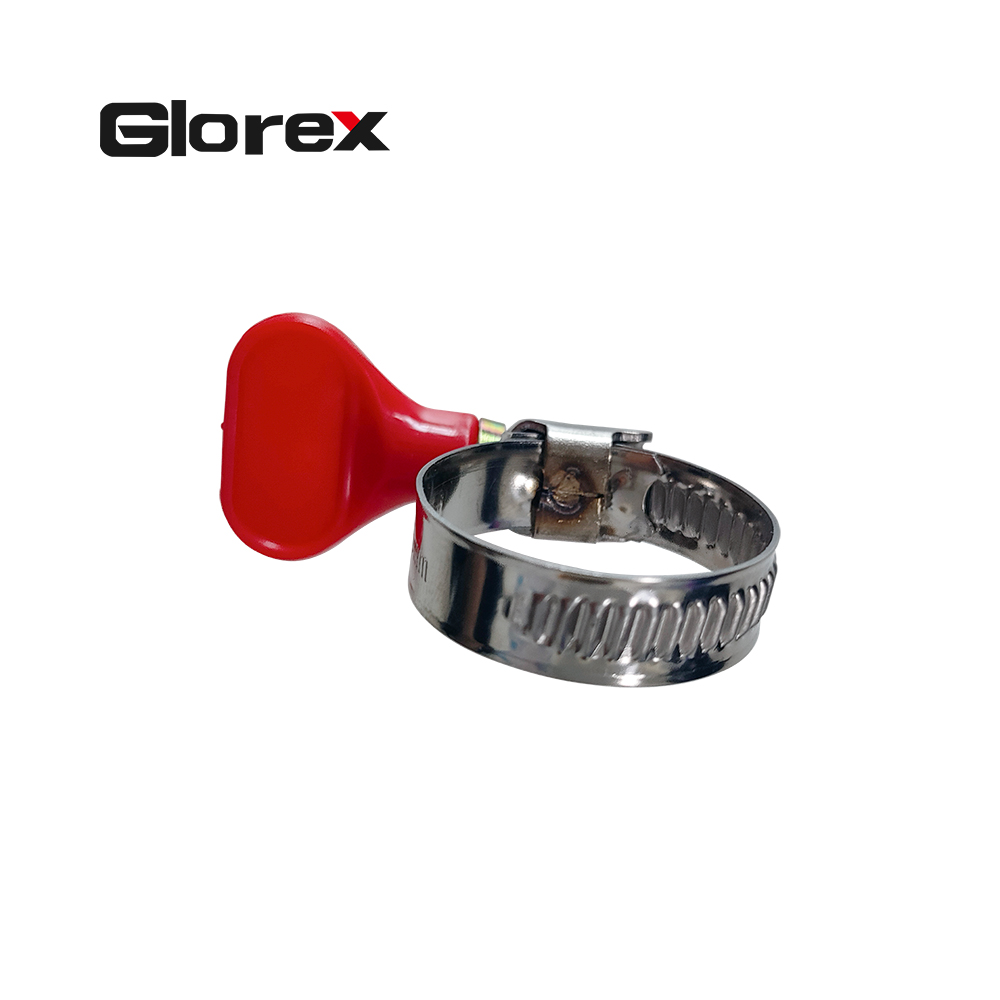
For radiator hose clamps specifically, this matters because radiator hoses are relatively soft and prone to compression set. A clamp that distributes load evenly will keep sealing longer than one that concentrates force at a narrow point. The industrial-quality W1–W5 German-type hose clamp with dovetail hoop shell is an example of this design approach applied across the full W1–W5 material range, which lets buyers match corrosion resistance to the specific application rather than over- or under-specifying.

Matching Clamp Size to Hose and Application
Clamp sizing is straightforward in principle and frequently wrong in practice. The clamp's specified range must cover the hose's outside diameter after it is fitted over the radiator neck or pipe. A hose that measures 38 mm on the bench may be 40–41 mm once installed, so a clamp with a 32–38 mm range will be at its limit or beyond it.
Practical rules:
Measure the hose outside diameter with the hose installed on the fitting, not loose.
Choose a clamp whose mid-range sits close to the measured diameter, leaving adjustment room in both directions.
Allow for hose swell and compression set over time—do not select a clamp that is already at maximum expansion.
For silicone hoses, use a clamp with a smooth inner band or a liner to avoid cutting the softer surface.
Installation Practices That Prevent Leaks
Even a well-specified clamp can leak if installed carelessly. A few habits make a measurable difference:
Position the clamp behind the hose bead, not on it. The bead provides a mechanical stop; the clamp seals just behind it.
Tighten evenly, not aggressively. Over-tightening deforms the hose and can cause the band to cut through. Follow the manufacturer's torque guidance where available.
Re-check after heat cycles. New hoses compress after the first few thermal cycles. A follow-up check after a week of service catches most settling-related leaks.
Avoid reusing old clamps on new hoses. The worm screw and band can wear, and a used clamp may not hold consistent tension.



About Us
Glorex manufactures and supplies industrial-grade hose clamps for automotive, industrial, and marine applications. Our product range covers W1 through W5 material grades, German-type dovetail hoop shell designs, and sizes suited to radiator, heater, and general hose assemblies. We focus on consistent band tension, corrosion-resistant materials, and dimensional accuracy—because in clamping, the details determine whether a joint holds for a season or for a decade.


FAQ
Q: What is the difference between W1 and W5 radiator hose clamps?
A: W1 clamps are zinc-plated steel throughout, suitable for low-corrosion environments. W5 clamps use stainless steel for the band, housing, and screw, making them suitable for wet, salty, or high-temperature conditions where long service life matters.
Q: Are German-type dovetail hose clamps better than standard worm gear clamps?
A: They distribute clamping force more evenly and reduce the risk of hose damage from overtightening. For soft radiator hoses and silicone hoses, that even pressure distribution often translates into a more reliable, longer-lasting seal.
Q: How do I choose the right clamp size for my radiator hose?
A: Measure the hose's outside diameter while installed on the fitting, then choose a clamp whose adjustment range comfortably covers that measurement—ideally with the diameter sitting near the middle of the range.
Q: Can I reuse radiator hose clamps?
A: It is possible but not recommended. Used clamps may have worn screw threads or stretched bands, and they may not hold consistent tension on a new hose. Replace clamps when replacing hoses.
Q: Do I need W5 clamps for a standard passenger car?
A: Not always. W4 is usually sufficient for typical engine bay conditions. W5 is the better choice for marine use, heavy equipment, or vehicles exposed to road salt and frequent wet conditions.
Hot Selling Products


Post time: Nov-09-2026


