



You’ve been there. You tighten a regular worm drive hose clip, feel it bite, and then spot the rubber bulging next to the housing. Or worse, a drop of coolant appears under the car a week later. That’s rarely a hose problem. It’s a clamp geometry problem.
Most universal worm clamps use a symmetrical band and a long housing. When you torque the screw, the housing tilts slightly, pulling the band tighter on one edge. This creates an uneven pressure ring that can pinch soft hoses, cut silicone, and leave tiny leak paths. Engine vibration makes it worse over time.
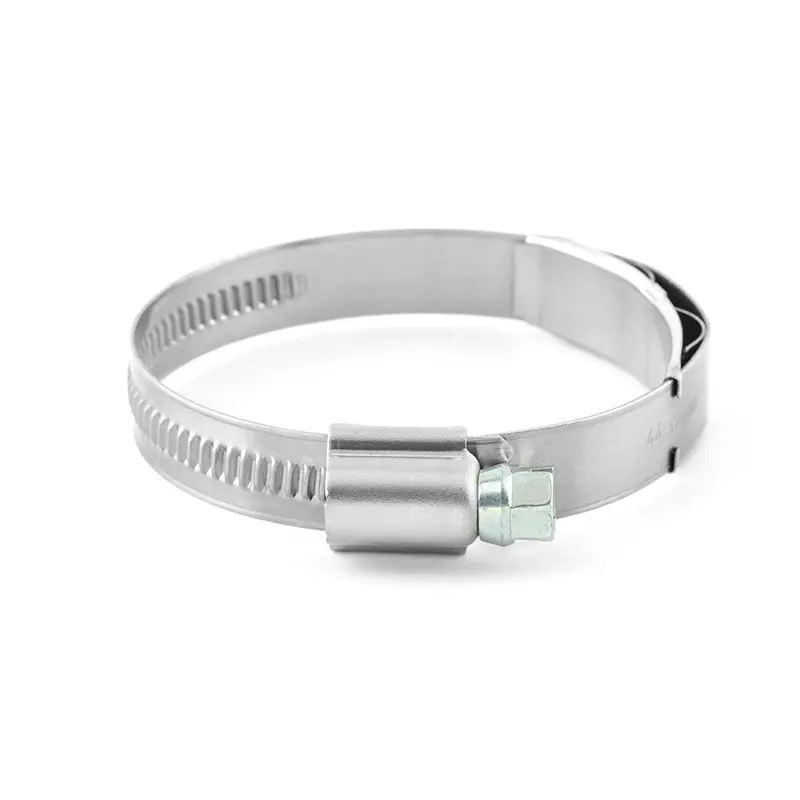
That’s exactly what the German-type eccentric hose clamp (DIN3017) was designed to fix.
What “Eccentric” Actually Means on a Clamp
The term “eccentric” here doesn’t mean weird. It refers to an asymmetric connection sleeve. The housing is shorter, and the band passes through it at a slight offset angle. Combined with a convex arc shape, this pulls the band evenly around the entire hose — no tilting, no hot spots. Once it’s torqued down, the fastening ring stays flat. The clamp becomes a true circle, not an oval that squeezes harder on two sides.
For a radiator hose clamp, that’s huge. Plastic radiator necks and older rubber hoses can’t take uneven bite pressure. The German eccentric spreads the load and seals without crushing.

Steel Matters – 304 or 430 Stainless?
Plenty of hose clamps use zinc-plated screws and 430 stainless bands to hit a price point. That works for indoor plumbing. Under the hood, you want a stainless steel hose clamp that won’t rust or lose torque after a few heat cycles. Two grades show up most often:
SS304 – Better corrosion resistance. Pick this for coolant lines, marine use, or outdoor hydraulic connections.
SS430 – Higher tensile strength, magnetic, and slightly less resistant to salt. It’s a solid choice for air intake pipes and dry mechanical fastening where budget matters.
Some builders run a mixed setup: 304 band and housing with a zinc screw for moderate conditions, or all-304 for high-humidity environments. The key is knowing what’s in the clamp, not just trusting the shiny surface.
Where German Worm Clamps Make a Visible Difference
A standard worm clamp works fine on a garden hose or a low-pressure return line. The German design earns its keep when things get tight and hot:
Radiator and coolant hoses – Even pressure on plastic spigots reduces the risk of cracking or cold leaks after winter park-up.
Turbo and charge pipes – Boosted silicone hoses try to push off. The DIN3017’s high destructive torque rating and flat clamping ring grip harder without cutting.
Tight spaces – The short housing sleeve and 9mm band width slide into spots where a bulky screw housing simply won’t clear.
Transport machinery – Constant vibration and thermal swing demand a stainless hose clip that stays put, not one that backs off a quarter turn every service interval.


How to Size a Clamp Without Guessing
Ignore the “one clamp fits most” approach. Measure the hose outer diameter with the hose installed on the fitting. Then pick a clamp where your measurement sits in the middle of the range. For example, if your hose measures 35mm OD, a 25–40mm clamp works, but a 32–50mm gives you more adjustment room and a better seal at the tail end of the band. The size chart for DIN3017 hose clamps lists ranges clearly, so you’re not left estimating.
Band width matters too. 9mm bands are ideal for barbed fittings with short spigots. 12mm bands provide a wider seating area for softer silicone or larger diameter coolant hoses. Both are available as stainless steel hose clips in multiple material combos.

Installation Nuance That Prevents Comebacks
Even the best clip won’t save a bad install. A few habits worth adopting:
Position the housing on a straight section of the hose, not on a bend or directly over a barb lip.
Use a torque-limiting driver if you’re working with plastic radiator inlets. 3–4 Nm is usually enough.
After the first two heat cycles, check the clamp. Silicone takes a compression set; a slight re-torque prevents weepage.
If the screw feels gritty during tightening, back it off and check for thread galling — stainless screws can gall. A small dab of anti-seize on the threads eliminates it.
The Bottom Line
None of this means a standard worm clip is useless. It means that when the connection matters — a radiator that’s a pain to pull, a turbo pipe you don’t want blowing off, a hard-to-reach industrial hose — the German eccentric DIN3017 design is a smart move. It costs a bit more up front and pays you back by not leaking, not loosening, and not eating the hose over time.
If you stock your shop with radiator hose clamps and stainless hose clamps that actually seal round, you’ll spend less time chasing small drips and more time getting the job done.
(Anchor link to product page: [Browse our full range of German-type stainless steel hose clamps →])


About Glorex
GLOREX is the hose clamp and pipe clip brand manufactured by Mika (Tianjin) Pipeline Technology Co., Ltd. We operate out of Tianjin, China, and our sole focus is connection reliability — making sure pipes and hoses stay sealed, no matter the conditions. From a single radiator hose clip to bulk stainless steel worm clamps for production lines, every order starts with the same question: Will it hold tight and last?
We are not a trading company guessing at specs. We design, stamp, assemble, and test in-house. That control over the entire process helps us deliver consistent tensile strength, consistent housing geometry, and honest material traceability — things that matter when a clamp sits on a turbo pipe or a military vehicle’s cooling circuit.
Media Contact:
Glorex Sales Department
Email: cathy@mikaclamp.com
Phone: 0086-18322014703
Website: https://www.glorexclamp.com


Hot Selling Products


Post time: Jul-23-2026


