



Why DIN3017 Still Matters in Industrial Hose Connections
If you have spent any time sourcing clamping hardware for European-standard equipment, you have probably come across the DIN3017 specification. It is one of the most widely referenced norms for worm-drive hose clamps in Germany and across Europe, and for good reason. The standard defines dimensional tolerances, band width, screw geometry, and material expectations that keep connections leak-free under vibration and pressure cycling.
In practice, a DIN3017 Germany type hose clamp is not just a generic metal ring. The band, housing, and screw need to work together within tight tolerances. Buyers who ignore the standard often end up with clamps that loosen prematurely, strip threads, or fail to distribute clamping force evenly around the hose.
This article walks through what makes a quality DIN3017 clamp, where the compensator dovetail hoop shell design fits in, and how to choose the right specification for your application.

What Defines a Genuine DIN3017 Clamp
The DIN3017 norm covers several band widths — commonly 9 mm, 12 mm, and 13 mm — and specifies the relationship between band thickness, screw diameter, and clamping range. A clamp that claims DIN3017 compliance but uses thinner band material or undersized screws will not hold torque the way the standard intends.
Key characteristics to verify:
Band material grade. Most industrial DIN3017 clamps use stainless steel in grades such as AISI 304 (1.4301) or AISI 316 (1.4401). The grade affects corrosion resistance, especially in marine, chemical, or food-processing environments.
Screw and housing fit. The housing should be riveted or welded securely to the band, and the screw threads should engage fully without binding. Poor housing alignment is a common cause of thread stripping.
Edge treatment. Burred or sharp band edges can cut into silicone or rubber hoses during tightening. Quality manufacturers deburr and round the band edges.
Compensator design. Some DIN3017 variants include a compensator feature that maintains clamping force as the hose relaxes or expands under temperature changes. This matters in applications with thermal cycling, such as engine cooling systems or industrial process lines.

The Compensator Dovetail Hoop Shell: What It Does
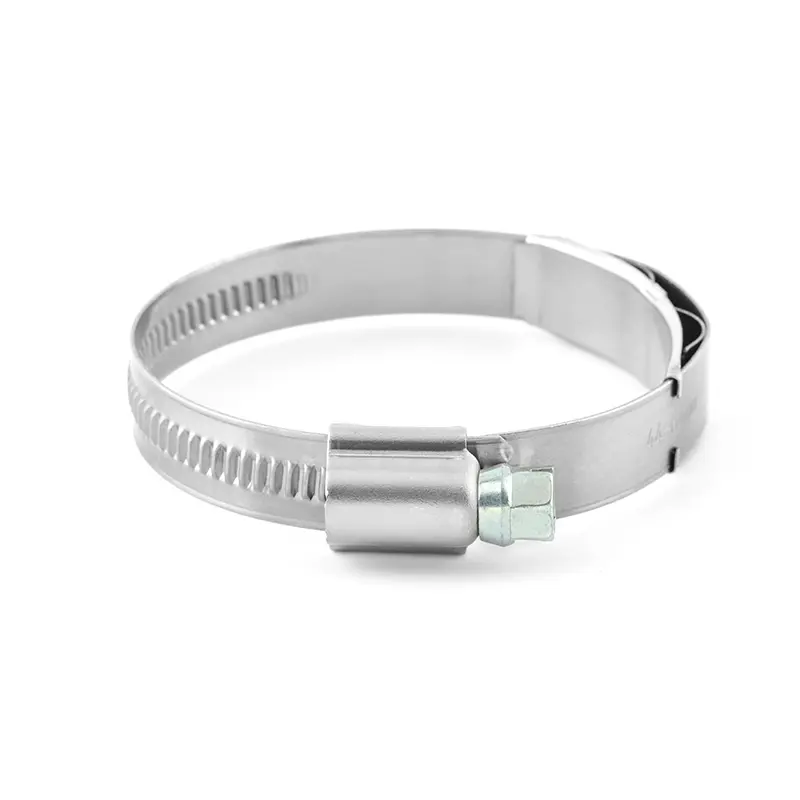
The compensator dovetail hoop shell construction is a specific design detail worth understanding. The "dovetail" refers to the interlocking shape where the band connects to the housing, which improves mechanical stability compared to simple spot-welded designs. The "compensator" element — often a spring-loaded or elastic section — allows the clamp to absorb minor dimensional changes in the hose without losing seal pressure.
For buyers, the practical benefit is fewer re-torquing cycles and reduced risk of leakage in dynamic applications. If you are specifying clamps for equipment that sees vibration, pressure pulses, or temperature swings, this design is worth the slight cost premium over basic worm-drive clamps.
You can see the specific construction in the industrial-quality DIN3017 stainless steel hose clamps with compensator dovetail hoop shell offered by Glorex Clamp, which follows this design approach.
Selection Checklist for Procurement Teams
When comparing DIN3017 Germany type hose clamps from different suppliers, use this checklist to avoid downstream problems:
Confirm the band width and clamping range against your hose OD. A clamp that is too narrow concentrates force; too wide may not fit the housing recess.
Verify material certificates. Ask for mill certificates or test reports for stainless steel grade.
Check torque specifications. Reputable suppliers publish recommended tightening torque. If they do not, that is a red flag.
Inspect the screw head type. Slotted, cross-recessed, and hex-head screws are all available; match to your assembly tools.
Evaluate corrosion resistance for your environment. 304 stainless is fine for most indoor industrial use; 316 is better for salt spray or chemical exposure.
Request samples before bulk orders. Fit and finish vary more than datasheets suggest.

Installation Notes That Affect Performance
Even a well-made clamp underperforms if installed poorly. A few field-tested reminders:
Lubricate the screw threads lightly before tightening to achieve consistent torque.
Tighten in stages rather than all at once, especially on large-diameter hoses.
Avoid over-tightening — it deforms the band and can cut the hose.
Re-check torque after the first thermal cycle in high-temperature systems.
These steps are simple but often skipped, and they account for a large share of field failures.


About Us
Glorex Clamp manufactures and supplies industrial clamping solutions, including DIN3017 Germany type hose clamps, stainless steel worm-drive clamps, and specialty compensator designs. Our production focuses on dimensional consistency, material traceability, and finishes that hold up in demanding environments. We work with distributors, OEMs, and maintenance teams across Europe, North America, and Asia to match clamp specifications to real application requirements. If you need technical data, samples, or a quotation, our team is ready to help.
Certificate


FAQ
Q: What is the difference between DIN3017 and other hose clamp standards?
A: DIN3017 is a German standard that specifies band width, material thickness, screw dimensions, and clamping ranges for worm-drive hose clamps. Other standards, such as DIN3016 or SAE J1508, differ in dimensional tolerances and are not always interchangeable.
Q: Is AISI 304 stainless steel sufficient for outdoor use?
A: For general outdoor industrial use, 304 is usually adequate. For coastal, marine, or chemical-exposure environments, 316 stainless steel offers better chloride resistance.
Q: Can the compensator dovetail hoop shell clamp be reused?
A: Yes, within reason. Inspect the band and screw for deformation or thread wear before reuse. Clamps that have been over-tightened should be replaced.
Q: What band widths are available for DIN3017 clamps?
A: Common widths are 9 mm, 12 mm, and 13 mm. The right choice depends on hose diameter, pressure, and housing space.
Q: Do you provide material certificates with orders?
A: Yes. Glorex Clamp can supply mill certificates and dimensional inspection reports on request. Contact us with your specification requirements.
Hot Selling Products


Post time: Oct-21-2026


